
Defibrillators
Do you have the tools and skills to save a life in a sudden cardiac arrest?
When sudden cardiac arrest strikes, having a defibrillator means you can step in with the tools to save a life before paramedics arrive. A defibrillator used within the first few minutes can increase survival rates up to 70%.
St John Defibrillators are easy to use and maintain, with technology you can count on when it matters most.

NEW: St John Pocket AED
Compact, portable and lightweight.

St John G5
Fully-automatic defibrillator with Intellisense™ CPR (iCPR) is the only AED to combine real-time CPR feedback with user-paced rescue prompting.

St John X3
Simple semi-automatic defibrillator with 5 inch LCD colour screen and one touch child mode.

Defib (AED) Maintenance
Information on how to set up, check and maintain your defibrillator.

Defib (AED) Consumables
View our range of AED batteries, pads, cabinets and other accessories.

CONTACT US
If you want purchase multiple AEDs, need a quote or want to discuss your options to ensure you get the right defibrillator for your organisation, our team are here to help.
Complete our enquiry form and our friendly team will get back to you.
4 Reasons why you need a Defibrillator (AED) during a sudden cardiac arrest:
- Defibrillation within the first few minutes of having a Sudden Cardiac Arrest increases the chance of survival to over 70%
- Without early defibrillation with an AED, less then 5% of cardiac arrest victims survive
- Without defibrillation, for every minute that passes, the chance of survival reduces by 10%
- Average Victorian ambulance response times are approximately 8-10 minutes in metro areas and up to 30 minutes in regional areas – defibrillation in combination with CPR gives victims the best chance of survival when waiting for Ambulance to arrive
LEARN MORE ABOUT THE ST JOHN G5 DEFIBRILLATOR (AED)
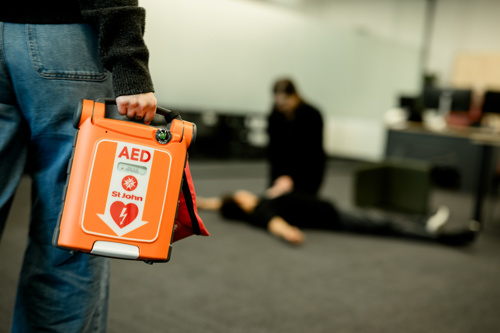
The St John Ambulance G5 with Intellisense™ CPR (iCPR) is the only AED to combine real-time CPR feedback with user-paced rescue prompting.
Find out why the G5 is right for you.
COMMON DEFIBRILLATOR MYTHS
LEARN MORE ABOUT THE St John X3 DEFIBRILLATOR (AED)
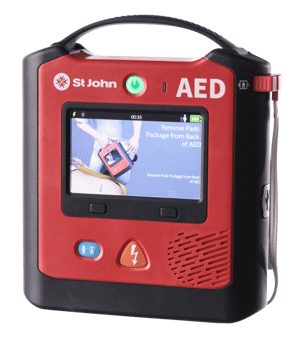
Lightweight yet robust, the St John X3 features a 5-inch LCD colour screen to help show you what to do, making it even easier to save a life.
Find out why the X3 Defibrillator is right for you.

Defibrillator 101

How to locate your nearest defibrillator

Defib myths debunked
Frequently Asked Questions About Defibrillators (AEDs)
Defibrillators (also known as AEDs or automated external defibrillators) are devices that restore a normal heartbeat by sending an electric pulse or shock to the heart. They are used to prevent or correct an arrhythmia - a heartbeat that is uneven or that is too slow or too fast. If an individual is showing signs of a cardiac arrest, a defibrillator can be used to return their heart to its normal rhythm. A defibrillator is very simple to use, most devices prompt you through exactly what to do. Basically to use, adhesive pads are applied to a bare chest, the device analyses the heart rhythm and a shock is administered if required.
The cost of a defibrillator can vary, depending on the brand and device, although typically they retail for $2,000-$3,000.
When purchasing a defibrillator it's important to assess the environment it's for. or example, the St John G5 defibrillator's rugged design withstands conditions like extreme temperatures, high altitudes, and vibration, making it well suited for workplaces such as building, construction, sporting facilities, and gyms. Defibrillators are expensive, because of the rigorous level of research and development that goes into each unit, so it's important that you speak to someone knowledgeable about the devices before purchasing one.
A defibrillator is a vital component in the chain of survival - a series of actions that when properly executed, reduce the mortality associated with sudden cardiac arrest. These actions include, early access, early CPR, early defibrillation and early advanced care. Early defibrillation is the link in the chain most likely to improve survival. Every minute without defibrillation decreases the chance of survival by 10%.
When it comes to sudden cardiac arrest, a defibrillator can be the difference between life and death, so it's very important all public places have one on hand in case of an emergency, which includes workplaces. While the Australian Resuscitation Council states having a defibrillator is good practice, there are no current regulations or guidelines around which businesses or industries should be required to have a Defibrillator. It is up to each business to assess their needs, their level of risk and make the decision.
A defibrillator provides a shock that interrupts the misfiring electrical signals that occur in ventricular fibrillation (otherwise known as chaotic or irregular heart beats). This shock then stops the heart momentarily, allowing it to reset and start rhythmically contracting again.
When it comes to defibrillation, energy matters more than current. In terms of shock efficacy, all biphasic waveforms are equivalent up to 200 joules. Not all patients convert at energy levels up to 200 joules.
Defibrillators are used about 1-2% of the time by the public in the event someone is suffering a sudden cardiac arrest. This is not enough to improve survival rates. Our goal at St John Ambulance is for 50% of patients who experience out of hospital cardiac arrest to receive defibrillation by 2023.
In Victoria a defibrillator can and should be registered with Ambulance Victoria https://www.goodsamapp.org/AV_AED . Registration is straightforward and easy and means that emergency services can direct GoodSAM community responders to their nearest defibrillator in the event someone is suffering a cardiac arrest nearby.
In most instances, it is unlikely that a baby will need an AED. Concentrate on giving effective CPR while you wait for an ambulance. However, for children under 8, specific infant/child pads, 'keys' or modes are available to adjust the electrical current delivered by the AED, so that it is suitable for children.
In most instances, it is unlikely that a child will need an AED. Concentrate on giving effective CPR while you wait for an ambulance. However, for children under 8, specific infant/child pads, 'keys' or modes are available to adjust the electrical current delivered by the AED, so that it is suitable for children.
A defibrillator needs to be maintained, this includes pads and battery checks to ensure they are not expired, display checks and full health checks every year by professionals. All AEDs perform self-maintenance checks on a daily, weekly and monthly basis to ensure that they are ready for use. In the event that the machine fails part of the test, the machine will beep to alert you that there is a fault with the machine.
Defibrillators can be purchased at St John but if funding is limited, there are a number of community grants that organisations can apply with to get a defibrillator.
A defibrillator can be applied to anybody who is unconscious or not breathing in attempting to help restart their heart.
The life on a defibrillator battery can vary depending on the manufacturer, most will need to be replaced every 2-5 years.
Except in the case of a small building, it is usually recommended that a minimum of one AED unit be placed on each floor of a workplace. It is also recommended that you calculate the response time using a route that includes stairs as opposed to an elevator. Any area that is difficult to access should have its own AED unit.
When someone is shocked by an AED you may see a very slight shoulder shrug or movement, but their arms and legs will not shoot up like in the movies.
A Cardiac Defibrillator Implant (ICD) is a small battery-powered device placed in your chest to monitor your heart rhythm and detect irregular heartbeat. An ICD can deliver electric shocks via one or more wires connected to your heart to fix an abnormal heart rhythm.
Cardiac arrest is one of the leading causes of death in Australia.
A cardiac arrest is an electrical malfunction that causes the heart to stop pumping as normal which prevents the body from oxygenating the blood or sustaining blood flow.
The electrical disruption to the hearts natural rhythm prevents the body from delivering adequate oxygenated blood flow to vital organs, in particular the heart and brain. When the heart is unable to pump blood around the body it will then go into cardiac arrest, causing it to stop completely.
When the heart begins to arrest the only way to get it back to its healthy rhythm is by providing a shock from a defibrillator. If someone who has suffered a cardiac arrest goes without defibrillation for more than 10 minutes, they are less than 5 per cent likely to survive.
A defibrillator will also advise a rescuer to provide CPR. A timely combination of CPR and defibrillation within the first few minutes, provides a casualty with their best chance of survival.
